


Kraft Paper Carry Bag vs. Plastic Carry Bag: Cost, Performance and Environmental Impact
Packaging buyers consider more than appearance and unit cost when deciding about paper versus plastic packing. Kraft Paper Carry Bags are printable and can potentially be recycled because they are in paper form and can be renewable. Plastic carry bags have moisture protection and can pack lighter, and provide more flexibility for the shape of the packaged product.
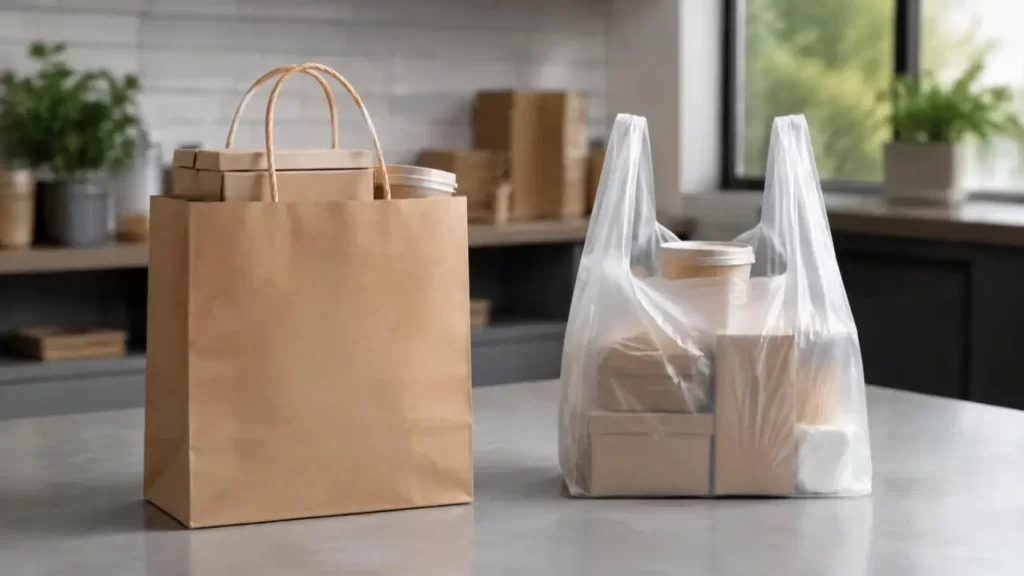
The correct choice depends on the complete packaging system: product weight, bag construction, exposure to moisture or grease, transport distance, reuse rate and local waste infrastructure.
Paper vs. Plastic: The Practical Difference
| Decision Factor | Kraft Paper Carry Bag | Plastic Carry Bag |
| Initial unit cost | Usually higher | Usually lower |
| Material use | Higher weight per bag | Low material weight |
| Load behavior | Rigid, stable and suitable for boxed goods | Flexible with high elongation |
| Wet performance | Strength decreases unless engineered for moisture | Naturally water-resistant |
| Brand presentation | Natural texture and high-quality print surface | Smooth surface with flexible printing |
| Storage and freight | More volume and weight | Compact and lightweight |
| Recovery route | Paper recycling when clean and compatible | Depends on local film collection |
| Litter risk | Fiber breaks down more readily | Persistent and may fragment |
Neither material wins every category. A technically suitable bag is one that completes the required carrying cycle without excessive material, failure or unnecessary secondary packaging.
Cost: Compare Total Packaging Cost, Not Bag Price
Plastic bags commonly have a lower purchase price because thin film uses less material and runs efficiently on high-speed production lines. A Kraft Paper Carry Bag may require heavier material, side gussets, a formed bottom and additional bonding operations.
Buyers should compare:
• Paper GSM or plastic film thickness
• Finished dimensions and gusset depth
• Handle and bottom construction
• Printing coverage and number of colors
• Setup costs divided across the order quantity
• Carton volume and inbound freight
• Failure, leakage and double-bagging rates
• Local plastic levies or packaging compliance costs
A lower-GSM Kraft Paper Carry Bag is not automatically more economical. If insufficient stiffness or bottom strength causes double-bagging, the effective cost can exceed that of a better-engineered specification.
Performance: GSM Alone Does Not Define Strength
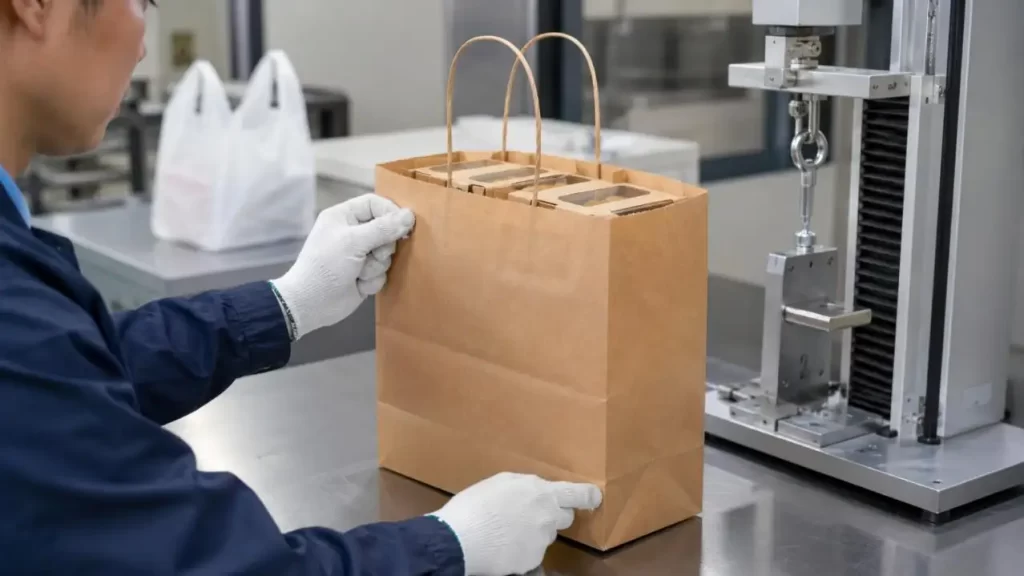
Paper basis weight is important, but it does not fully predict carrying performance. Kraft fiber quality, machine direction, cross direction, moisture content, fold geometry and adhesive coverage also affect the finished bag.
A professional examination must take into consideration the following:
• Static Load: Can the bag support the product for the necessary period of time?
• Dynamic Load: Will the bag hold up to the stresses of lifting, walking, and transporting by vehicle?
• Bottom Integrity: Will the bonded base stay intact with the closing load?
• Handle Pull: Will the handles and reinforced regions resist tearing?
• Puncture Resistance: Will the bag hold up to the stresses of impact with sharp/irregular corners or impact with rigid containers?
• Wet Strength: Will the bag hold up to the stresses of humidity and rain?
Plastic film is more forgiving in terms of structural integrity and water resistance with the ability to recover from loading stresses over an irregular structure. A Kraft Paper Carry Bag offers dimensional stability and retains its shape, tending to support upright meal boxes and/or bakery/retail items, as long as its base and gussets are sufficiently large.
Food Packaging: Considerations for Barrier and Safety
For lunch, bakery and takeaway packaging, performance is affected by the presence of steam and condensation as well as grease. Untreated Kraft paper may lose strength by absorbing the grease and become more permeable. While barrier treatments may provide some protection, buyers should check whether the coating has any effect on repulpability or whether it generates a potential food contact concern.
GT GROUP's recyclable kraft paper lunch bag provides a starting point for food storage and carrying applications. From our manufacturing perspective, the selected Kraft Paper Carry Bag should be matched to the actual food container, load and exposure conditions rather than described simply as "food-grade" or "eco-friendly."
Relevant checks include:
• Food-contact documentation
• Grease-resistance requirements
• Expected food temperature
• Exposure to condensation
• Barrier or coating composition
• Ink and adhesive suitability
• Recycling instructions for the finished structure
This is increasingly important in Europe, where the Packaging and Packaging Waste Regulation restricts PFAS above defined limits in food-contact packaging and introduces broader recyclable packaging requirements. European Commission
Environmental Impact: Use a Functional Unit
Comparing one paper bag with one plastic bag can be misleading. A better lifecycle assessment uses a functional unit such as 1,000 successfully completed carrying events.
The analysis should cover:
- Raw materials: Virgin or recycled fiber versus virgin or recycled polymer
- Manufacturing: Energy, water, converting waste and bag weight
- Distribution: Transport distance, carton volume and pallet efficiency
- Use: Failure rate, double-bagging and realistic reuse
- End of life: Collection, recycling, incineration, landfill and litter
Paper is renewable and widely collected in many markets, but producing a heavier bag can require more resources. Plastic uses less material and is efficient to transport, yet flexible-film recycling is not consistently available and escaped plastic persists in the environment.
A 2011 UK Environment Agency study estimated that, under its assumptions, a paper bag needed to be reused at least three times to achieve lower global-warming potential than a conventional HDPE bag used once. This is not a universal threshold: bag weight, electricity mix, transport, reuse and disposal conditions can change the result. UK Environment Agency
Which Bag Fits Which Application?
| Application | Recommended Starting Point | Main Reason |
| Bread, pastries and dry food | Kraft Paper Carry Bag | Stable structure and paper recovery route |
| Boxed lunch and café takeaway | Block-bottom kraft bag | Keeps containers upright |
| Wet or leaking products | Plastic or tested barrier bag | Higher moisture resistance |
| Heavy or sharp products | Reinforced, load-tested structure | Strength must be verified |
| Plastic-reduction program | Right-sized kraft bag | Reduces conventional plastic use |
| Closed-loop film collection | Recycled plastic may be viable | Recovery infrastructure already exists |
Specifying a Kraft Paper Carry Bag with GT GROUP
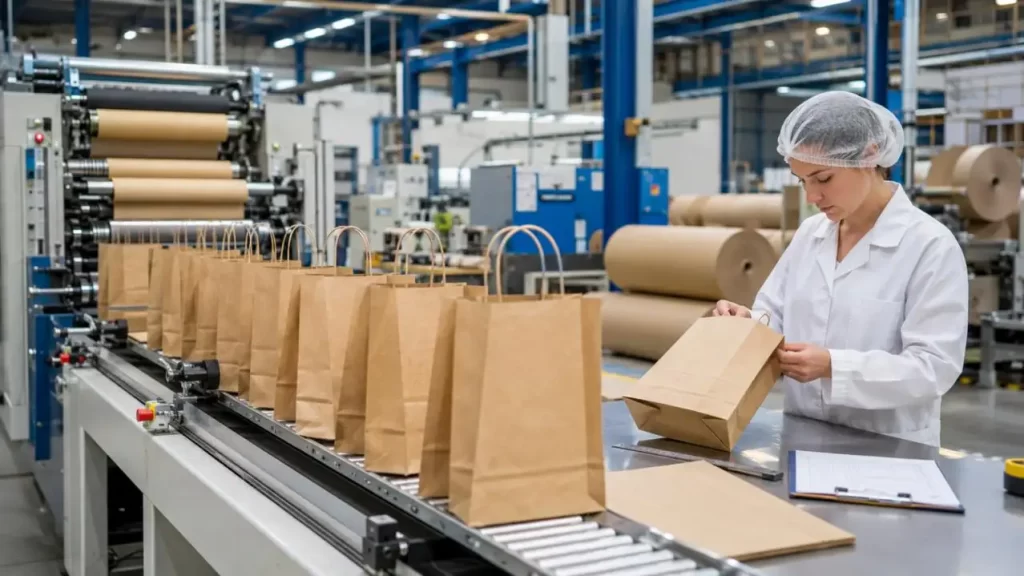
At GT GROUP, we translate the application into measurable specifications. Buyers can discuss:
• Bag width, gusset, height and expected load
• Paper type and GSM
• Flat or block-bottom construction
• Handle or handle-free design
• Grease and moisture exposure
• Custom colors, logos and print coverage
• Samples and acceptance criteria
• MOQ, packing method and delivery schedule
Customizing the size, material, thickness and printing allows a Kraft Paper Carry Bag to be evaluated against its actual job—not against a generic plastic bag.
Final Assessment
Plastic bags retain practical advantages in unit cost, weight and wet conditions. A Kraft Paper Carry Bag is often the stronger choice for dry food, takeaway, bakery and retail projects that prioritize structural presentation, plastic reduction and paper-based recovery.
The best result comes from right-sizing the bag, validating its load performance and confirming how the finished structure will be recovered locally. Businesses assessing a custom Kraft Paper Carry Bag can contact GT GROUP to review material, dimensions, printing and application requirements before bulk production.
FAQs
Q1. What Kraft Paper Carry Bag applications does GT GROUP support?
GT GROUP supplies recyclable kraft paper bags for carrying boxed lunches, bakery products, packaged snacks, takeaway orders and selected retail goods. The final specification should be matched to the product weight, dimensions and exposure conditions.
Q2. Can GT GROUP customize the size of a Kraft Paper Carry Bag?
Yes. Buyers can specify the bag width, gusset depth and height according to their containers or products. Right-sizing helps reduce excess paper, improve loading stability and control packaging costs.
Q3. Can GT GROUP customize paper GSM and bag construction?
GT GROUP can discuss paper weight and structural requirements based on the expected carrying load. Available options may include different bottom formats, gussets and handle configurations, subject to project requirements.
Q4. Does GT GROUP provide custom printing?
Yes. GT GROUP supports custom logo, color and artwork printing. Buyers should provide the artwork file, printing area, color requirements and expected order quantity so that the appropriate printing process can be evaluated.
Q5. How does GT GROUP determine the appropriate paper GSM?
Paper GSM is selected according to bag dimensions, product weight, load distribution and required stiffness. GT GROUP may also consider bottom bonding, handle reinforcement and whether the bag will encounter moisture or grease.
Share on Social:


